
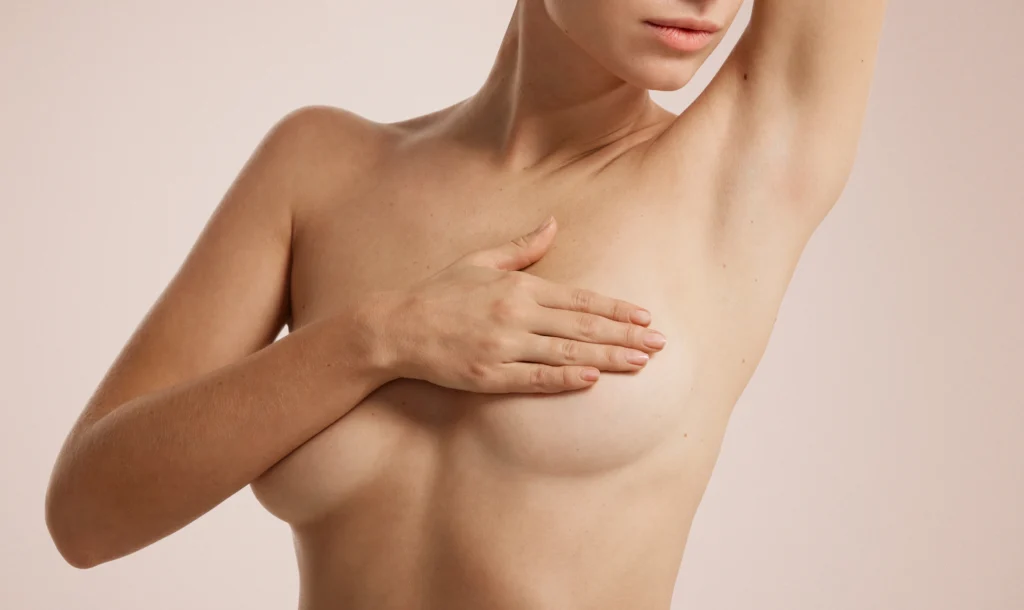
Breast Augmentation
Breast augmentation with fat or implants (breast augmentation) is one of the most common plastic surgery procedures.
Breast shape, size, and appearance are determined by numerous factors—from age, heredity, and weight changes to pregnancy, sun exposure, physical activity, or congenital characteristics. During surgery, breast implants or the patient’s own fat may be used for body contouring. The recommended method typically depends on the patient’s body structure and expectations, discussed together with the plastic surgeon during consultation.
Breast augmentation helps restore volume, shape, and firmness after weight loss or pregnancy, create a more proportionate silhouette, and reduce visible breast asymmetry. Women dissatisfied with their breast size, shape, or appearance can consult a plastic surgeon and choose the most suitable augmentation method for them.
Procedure Steps
The course of surgery differs depending on whether breast enlargement with fat or breast augmentation with implants is chosen. The surgical process is also influenced by the type of incision when implants are used.
At the Tautrimas Aštrauskas Clinic, breast augmentation is performed using three methods. When enlarging the breasts with implants, top-quality Motiva, Polytech, and Mentor implants are used.
Depending on the patient’s anatomy, if needed, physicians use a hybrid breast augmentation method. In such surgery, both breast implants and fat transfer are used. Fat transfer is advisable in cases of a wide gap between the breasts or uneven breast size.

Breast Augmentation with Implants, Inframammary Incision
Implants are placed using the dual plane method: partially under the muscle and partially under the gland. Inframammary incision length: 4–4.5 cm, depending on implant size. The scar usually hides in the inframammary fold.
Breast Augmentation with Implants, Transaxillary Incision
The incision is made in the axillary fold, 3–4 cm long; the scar often remains barely visible in the armpit area. Implants are placed using the dual plane method: partially under the muscle and partially under the gland.
Krūtinės didinimas riebalais (riebalų persodinimas)
This method involves liposuction of fat from body areas, special preparation, and transplantation into the breasts. About 70% of the transferred fat survives after surgery.
When and for whom is breast augmentation performed?
Breast Augmentation with Implants
Krūtų didinimas per pažastį negalimas, jei krūtys yra pasmukusios ir joms reikalingas krūtų pakėlimas. Tačiau tais atvejais, kai krūtų forma yra tinkama, šis metodas pasižymi aiškiais privalumais: mažesnė komplikacijų tikimybė, randas lieka beveik nematomas, jo nereikia slėpti ir jis nekeičia savo vietos. Svarbu žinoti, kad pažasties pjūvio metu nepažeidžiami limfmazgiai ir limfagyslės. Šis metodas pasaulyje atliekamas vos 5 proc. gydytojų. Mūsų klinikoje jį jau 18 metų nuolat atlieka plastinės ir rekonstrukcinės chirurgijos gydytojas Tautrimas Aštrauskas. Nors šis metodas saugus ir patikimas, jis reikalauja aukštos kvalifikacijos, preciziškumo ir ilgametės patirties.
Breast Enlargement with Fat
This surgery is suitable for patients who do not want a foreign body in their body. With this method, the breast can be increased by 1–1.5 sizes. For a more pronounced result, the surgery can be repeated, but not earlier than 6 months after the first procedure. About 70% of the transferred fat survives—this outcome is supported by years of practice, special technique, and an experienced team. Note that breast enlargement with fat is suitable only for patients who have sufficient fat in other body areas to use for augmentation.
General Recommendations
If you are planning breast augmentation, at least 4–6 months should pass after childbirth and breastfeeding. If you have chronic diseases, you must consult with the operating surgeon and the anesthesiologist.
Procedure duration
Breast augmentation with implants, inframammary incision:
1–1.5 h
Breast enlargement with fat:
2–2.5 h
Breast augmentation with implants, transaxillary incision:
30–40 min
Procedure duration
Breast augmentation with implants, inframammary incision:
1–1.5 h
Breast enlargement with fat:
2–2.5 h
Breast augmentation with implants, transaxillary incision:
30–40 min
The surgery price
Includes
surgery
general anesthesia
overnight stay at the clinic
medications
nutrition
compression garments
postoperative check-ups at the T. Aštrauskas Clinic, Vičiūnų g. 24, Kaunas
–
Price
| Breast Augmentation with Implants | 4,200 EUR |
| Breast Augmentation with Fat | €4,500 |
| Breast augmentation with “B-lite” implants | 5500 EUR |
| Breast Augmentation and Lift (price with breast implants) | from 4500 EUR |
The exact surgery price will be determined during the consultation when the surgeon assesses the complexity of the surgery.
Preparing for Breast Augmentation Surgery
– A consultation with the operating doctor is necessary before the procedure.
– If you have chronic diseases or other ailments, take medications or dietary supplements, or have had other surgeries in the past, please inform us during the consultation.
– Preoperative blood tests are required to assess the patient’s overall health and determine whether the chosen surgery is safe to perform.
– We recommend a breast ultrasound before surgery and, if indicated or risk factors are present, a mammogram.
Postoperative Period
– More pronounced swelling and bruising are observed for 2–3 weeks after surgery, and scars and breasts may continue to mature for up to 1.5–2 years.
– Wear a compression bra for 1–3 months after breast augmentation. The exact duration may vary depending on the individual situation.
– After the procedure, we recommend a course of manual lymphatic drainage massages. These massages stimulate lymph flow, normalize blood circulation, and are particularly beneficial in reducing tissue swelling and promoting faster healing after the procedure.
– The healing process is accelerated by physiotherapy procedures using laser, radio frequency, and magnet.
– Nipple sensitivity (if present beforehand) and the ability to breastfeed are preserved after breast augmentation surgery.
– Recovery after augmentation with implants through the armpit versus an inframammary incision differs only in that arm movements should be limited for up to 2 weeks after an axillary incision.
– In the first days after any breast augmentation method, a feeling of tightness is common and is alleviated with the recommended medications.
Breast Augmentation: Preparation
Breast augmentation surgery raises many questions and doubts for many women. Therefore, preparation for breast augmentation surgery always begins with a comprehensive consultation with a plastic surgeon. Plastic and reconstructive surgeons encourage patients to prepare a list of relevant questions in advance so that the consultation is as effective as possible and no uncertainties remain afterward. Patients attending a consultation should also prepare information about medications they are taking and any existing health issues for the doctor.
During the consultation, all questions are discussed and the patient’s expectations are heard. The doctor evaluates individual anatomical features, breast position, health status, and performs necessary examinations. Typically, blood tests and breast ultrasound are performed before breast augmentation surgery. If certain risk factors are encountered, a breast mammogram may also be performed.
Based on the information gathered during the consultation, the doctor selects the optimal surgical method, implant shape, and size.
It is important to know that at Tautrimas Aštrauskas Clinic, breasts can be corrected in several ways. Breast augmentation options include:
– Breast augmentation with implants through an incision under the breasts;
– Breast augmentation with implants through an incision in the armpit area;
– Breast augmentation with implants using the “preserve” method (preserving the natural breast structure);
– Breast augmentation with fat;
– Hybrid breast augmentation using breast implants and fat transplantation.
Once the optimal breast augmentation method is chosen, the doctor describes the exact course of the surgery and introduces the expected results.
For patients who cannot plan a visit to the clinic, an initial consultation can also be provided remotely. Before the remote consultation, the patient must send photos of her breasts to the doctor. This way, the doctor can at least preliminarily assess the current situation and recommend the optimal correction method. If, after the remote consultation, the patient decides to undergo breast augmentation surgery, a visit to the clinic is planned.
What not to Do after Breast Augmentation Surgery
– Physical exertion. Depending on the nature of the surgery performed, you should avoid sports activities and intense physical work for at least 1 to 3 months after breast augmentation.
– Direct sunlight. Direct sunlight negatively affects incision sites and can lead to prominent scarring, so they should be covered.
– Bodies of water. You should avoid swimming in natural bodies of water and public pools for at least 2 months after surgery.
– Saunas and solariums. Exposure to solariums and natural sunlight can darken scars. Tanning should be avoided for one year after surgery. If you do not wish to postpone tanning rituals for a year, you can enjoy sunbathing at least one month after surgery. However, in such cases, incision sites should be carefully protected and covered.
– Wearing regular bras. After breast augmentation surgery, you should use compression bras instead of regular ones for 1 to 3 months. The exact duration for wearing compression bras is determined by the doctor, as it depends on the nature of the surgery performed.
– Taking self-prescribed medications. The use of any medications related to the surgery or otherwise should be discussed with your doctor.
– Restricting arm movements. After breast augmentation surgery with implants, you may need to limit arm movements, especially for patients who had breast augmentation with implants through the armpit. Arm movement restrictions may be felt for 2 weeks after surgery.
– Laser hair removal. This restriction applies only to patients who had breast augmentation through the armpit. Laser procedures should be avoided for at least 2 months after surgery. Later, the procedure can be performed, but scars must be covered.
– Lifting heavier weights. In the first weeks after surgery, it may be somewhat difficult to raise your arms, and lifting objects weighing more than 5 kg is not recommended. Therefore, you should plan your usual activities in a way that does not cause this discomfort, for example, by enlisting the help of family members.
Recovery after Breast Augmentation Surgery
After breast augmentation surgery, you will need to spend one night at the clinic. The next day, dressings will be changed, recovery period recommendations will be provided, necessary supplies will be issued, and medications will be prescribed. After these procedures, you may go home.
One week after surgery, the first postoperative visit is scheduled at the clinic. Subsequent visits are planned after one, two, and six months. The need for suture removal is avoided, as dissolvable sutures are used during the surgery. In cases where the doctor decides to leave drains for fluid drainage after surgery, the visit schedule is arranged individually.
About a month after surgery, you will be able to start using scar gels that promote faster and more aesthetically pleasing scar healing.
Frequently Asked Questions
Ar implantus reikia keisti? Kas kiek laiko?
Krūtų implantų keisti nereikia, jei jie sveiki, nepažeisti, neplyšę. Tai įvertinti galima kas metus atliekant krūtų ultragarsinį tyrimą (krūtų echoskopija).
Kai kurie gamintojai netgi suteikia garantijas visam gyvenimui, tačiau kartais dėl vienų ar kitų priežasčių apie implantus susiformuoja kietas jungiamojo audinio apvalkalas (kapsulės kontraktūra). Tokiais atvejais reikia pasitarti su plastikos chirurgu ir individualiai spręsti dėl poreikio keisti implantus. Gyd. Tautrimo Aštrausko praktikoje kur kas dažnesnė praktika – implantų keitimas ne dėl defektų, o dėl pakitusių pacientės lūkesčių – pavyzdžiui, norimo kito dydžio ar formos.
Kokia operacijos kaina?
Kaina nuo 3700 Eur.
Kokie implantai naudojami?
Motiva, Polytech, Mentor implantai.
Po kiek laiko galėsiu grįžti į darbą?
Kiekvienas organizmas labai individualus ir darbo pobūdis skiriasi. Kai kuriais atvejais moterys puikiai jaučiasi ir dirbti gali praėjus kelioms dienoms po operacijos, tačiau rekomenduojame gijimui skirti bent 1 savaitę.
Kiek laiko turėsiu vilkėti kompresinę liemenėlę?
1-3 mėnesius po krūtų didinimo operacijos rekomenduojame vilkėti kompresinę liemenėlę. Tikslesnis laikotarpis gali varijuoti atsižvelgiant į individualią situaciją.
Kada galima maudytis po krūtų didinimo operacijos?
Maudytis galima jau po 3 dienų nuo operacijos. Jei pacientei ilgiau laikomi drenai, maudytis galima sekančią dieną po drenų pašalinimo. Esant su drenais, maudytis negalima. Viešų vandens telkinių, SPA, pirčių vengti 1 mėnesį po operacijos.
Kada galima miegoti ant pilvo po krūtų didinimo operacijos?
Jausti diskomfortą gulint ant pilvo galite iki 3 mėnesių.
Ar po krūtų didinimo riebalais reikia vilkėti kompresinę liemenėlę?
Priklauso nuo individualios situacijos.
Kada galima sportuoti?
Priklausomai nuo operacijos metodo: nuo 1 iki 3 mėn. po operacijos atlikimo.
Ar galėsiu gimdyti ir maitinti krūtimi po krūtų didinimo implantais?
Dažniausiai moterys po krūtų didinimo implantais gali sėkmingai žindyti ir, be jokios abejonės, gimdyti. Vis tik kartais maitinti krūtimi gali ir nepavykti. Tai visų pirma priklauso nuo to, kokiu būdu buvo dėti implantai. Didžiausia rizika sutrikdyti normalų žindymą yra tada, kai krūtų implantai dedami per pospenelinį (areolės) pjūvį, nes taip dedant krūtų implantą yra pažeidžiama ir dalis pieno latakų. Taip pat derėtų pabrėžti, kad pieno gamyba, jo nutekėjimas ir sėkmingas žindymas labai stipriai priklauso nuo nusiteikimo, mamos ir vaiko emocinio ryšio, bei tinkamos maitinimo technikos. Todėl nepavykus iš pirmo karto nereikia nuleisti rankų ir manyti, kad implantai – pagrindinė priežastis.
Kiek laiko turėsiu praleisti ligoninėje po krūtų didinimo implantais?
Įprastai jau kitą dieną po krūtų didinimo implantais pacientė gali važiuoti namo. Tačiau kaip ir daugelio dalykų medicinoje, to griežtai tvirtinti negalima. Pasitaiko, kad stacionare pacientė paliekama dar dienai, rečiau – dviem. Šį sprendimą lemia bendra pacientės būklė ir savijauta po operacijos.
Ar lieka randai po krūtų didinimo implantais?
Taip, randai po krūtų didinimo implantais lieka visais atvejais, tačiau kai kuriais jie pastebimi lengviau, kai kuriais – beveik visai nematomi. Jei krūtų didinimas atliktas techniškai gerai, organizmas į operacinius pjūvius reaguoja įprastai ir pavyksta išvengti komplikacijų. Randai sugyja pakankamai gražiai ir juos nesunku užmaskuoti. Skirtingi chirurgai specializuojasi skirtinguose krūtų didinimo metoduose – gyd. Tautrimas Aštrauskas pirmenybę teikia krūtų didinimui implantais per pažasties pjūvį, nes randas lieka natūralioje odos raukšlėje ir nepakėlus rankų yra visiškai nematomas.
Ar po krūtų didinimo galima atlikti mamogramas?
Taip. Moterims su krūtų implantais, kaip ir visoms kitoms, rekomenduojama nuo 50 metų dalyvauti visuotinėje krūtų patikroje. Tokio amžiaus moterims idealus tyrimas ankstyvai vėžio diagnostikai – mamografija. Jei moteris žino, kad jos artimų giminių tarpe yra krūties vėžio atvejų, tirtis rekomenduojama jau anksčiau. Tokiu atveju gali būti rekomenduotas ir ultragarsinis krūtų tyrimas, kuriam implantai taip pat nėra kontraindikacija.
Man 50 metų. Ar aš per sena krūtų didinimo operacijai?
Svarbiausia yra pacientės sveikata, o ne amžius. Krūtų didinimą galima atlikti bet kokiame amžiuje. Svarbiausia – atsižvelgti į tuos rizikos veiksnius, kuriuos turi konkreti pacientė. Žinoma, su amžiumi rizikos veiksnių dažnai daugėja, tačiau būna ir atvirkščiai.
Ar galima naudotis soliariumu arba degintis saulėje, jeigu man atliktas krūtų didinimas?
Deginimasis soliariume arba saulėje nekenkia implantams, tačiau gali išryškinti pjūvių vietose esančius randus. Turėtumėte vengti deginimosi po operacijos bent metus laiko, kadangi dėl spindulių poveikio randai patamsėja („įdega“). Jeigu, praėjus 1 mėnesiui po operacijos, vis dėlto nusprendžiate lankytis soliariumuose, tuomet siekiant išvengti randų „įdegimo“ patariame degintis juos prisidengus. Implanto temperatūra, kaip ir žmogaus kūno, deginimosi metu šiek tiek pakyla. Implantas gali vėsti šiek tiek ilgiau nei kūnas.
Ar krūtis galima padidinti savais riebalais?
Taip. Tiek krūtų, tiek riebalų persodinimu taip pat lyginamos veido raukšlės, jauninama veido, kaklo ar rankų oda. Riebalai persodinimui imami iš paties paciento paodžio specialia kiurete, panašiai kaip ir riebalų nusiurbimo metu. Po to jie paruošiami ir suleidžiami į reikiamą vietą.
Ar įmanomas krūtų didinimas natūraliu būdu?
Krūtų didinimas, persodinant savus riebalus, yra vienas natūraliausių ir efektyviausių krūtų didinimo metodų, šiuo metu taikomų plastinėje chirurgijoje. Atliekant šią operaciją nenaudojami jokie implantai, todėl negalimos jokios organizmo reakcijos, susijusios su svetimų audinių atmetimu. Riebalai į krūtis suleidžiami specialia kiurete, todėl nereikalingi jokie pjūviai. Norint padidinti riebalų persodinimo efektą, gyd. Tautrimas Aštrauskas savo pacientėms siūlo ir išorinę minkštųjų audinių plėtimo priemonę (BRAVA) – specialų prietaisą, kuris palaiko nuolatinį švelnų neigiamą slėgį, dedamą ant krūtų. Neigiamas slėgis tempia audinius ir skatina jų natūralų augimą.

